


The Right Target Audience for Your Fundraising Campaign: 5 Motivations and 4 Ways to Reach Them

25.08.2026

Global Group
Whoever reaches the right people with the right message increases the chances of successful fundraising campaigns. But what actually motivates people to donate? And how can this knowledge be used for campaign planning?
For fundraisers, successful audience planning today means more than simply reaching as many people as possible. The key is to identify people who have a strong affinity with your cause and understand what motivates them to donate.
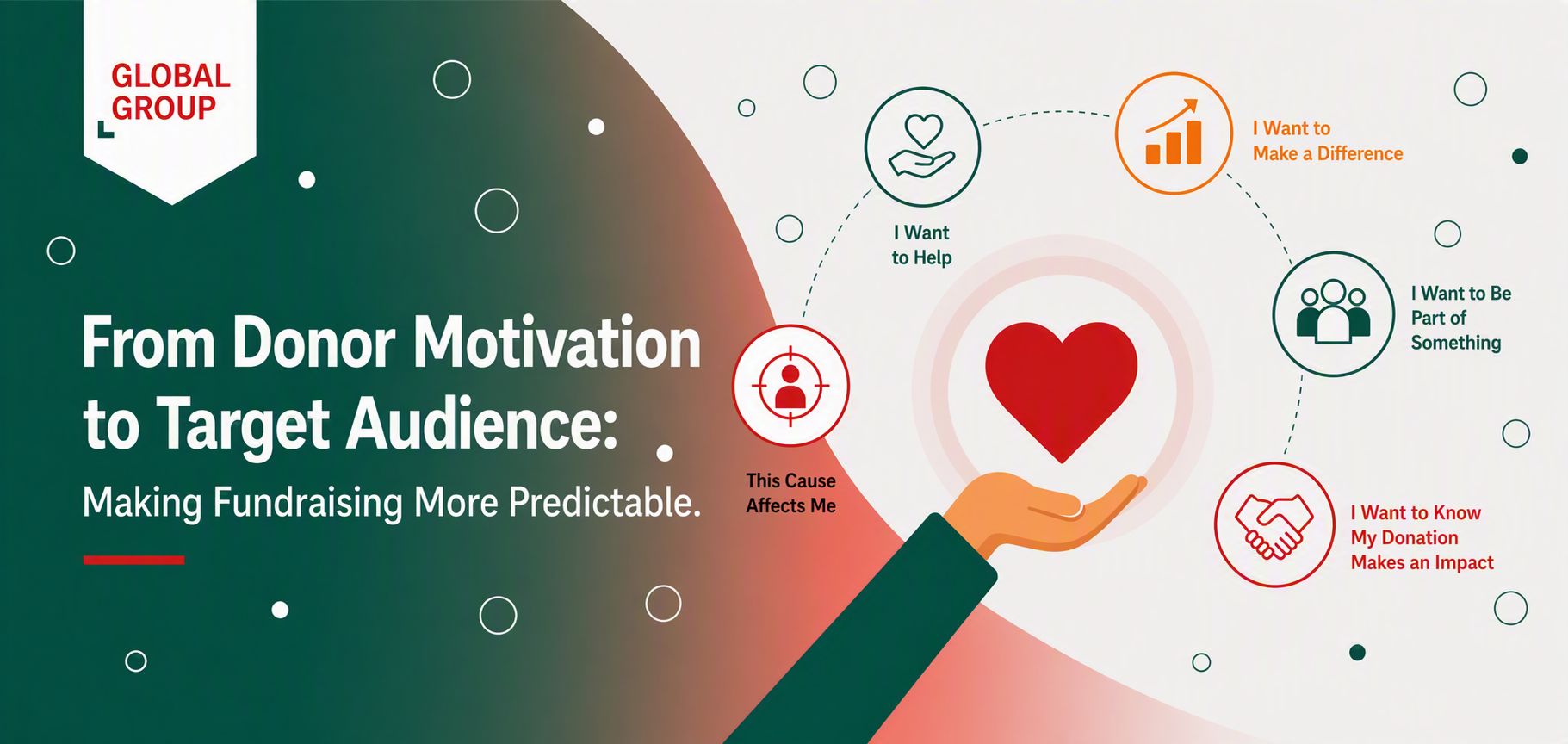
Because people donate for different reasons. For some, a personal connection to a cause is decisive, while others primarily want to see tangible impact. Still others feel a strong connection to a particular organization or social cause.
We present five key donation motivations and explain how fundraisers can take them into account when planning campaigns. We then introduce four ways to identify, analyze, and target audiences even more precisely.
1. “I want to help” – Compassion as a motivation
The desire to help is one of the most obvious donation motivations. People see a situation of need and want to help alleviate it – for example, when it comes to people living in poverty, children in need, or animal welfare.
For campaign planning, this means: Show specifically who the donation will help. The more tangible the situation and the potential impact of the donation, the easier it is for potential donors to establish an emotional connection.
It is also worth looking at the audience’s affinity with specific causes: Someone who has already donated to animal welfare, for example, may generally be more willing to support another animal welfare project.
Planning question for fundraisers:
Which people have already shown an interest in our field and how can we use this affinity for our campaign?
2. “I want to make a difference” – The desire for impact
Many people want their donation to do more than simply provide support – they want to make a difference. They want to know: What will change as a result of my contribution?
This means that communication should go beyond simply describing the problem. Instead of only showing what is wrong, a campaign should communicate what specific change is possible.
This could mean making the use of donations as tangible as possible or demonstrating the long-term impact of a project.
Planning question for fundraisers:
What change can we make possible, and can we communicate it in such a concrete way that potential donors can see their own contribution as part of it?
3. “This issue affects me” – Personal connection creates closeness
Another important factor is personal connection. People often support causes they have experienced themselves or that affect people close to them.
This could be a disease, but equally their local community, a particular animal species, environmental issues, or a social cause that is especially important to them.
For fundraisers, this means: Not every audience needs to be addressed with the same message. The better you understand the interests and lifestyles that shape an audience, the more precisely you can tailor your communication.
Planning question for fundraisers:
What personal or regional similarities connect our potential donors to our cause?
4. “I want to know that my donation will make a difference” – Trust and transparency
Donating is an act of trust. Particularly when it comes to long-term engagement, supporters want to know what happens to their money and what impact their donation has.
That is why transparency, credibility, and demonstrable impact are key elements of successful fundraising communication.
For campaign planning, this means considering not only who you want to reach, but also what information these people need to build trust and make a donation decision.
Planning question for fundraisers:
Which arguments and information create trust among our target audience, and how can we communicate these as part of the campaign from the outset?

5. “I want to be part of something” – Community and shared values
Donating can also be an expression of personal values and identity. People support organizations because they share their goals and want to be part of a community that is committed to a particular cause.
This applies, for example, to environmental and nature conservation, human rights, or social justice.
For fundraisers, this opens up another opportunity: A campaign can do more than ask for support – it can give people the feeling that they are part of something and can make a difference together.
Planning question for fundraisers:
Which values do we share with our potential supporters – and how can we strengthen this sense of community through our campaign?
From Donation Motivation to the Right Target Audience
The five motivations show that successful fundraising marketing does not begin with the mailing, ad, or landing page.
It begins with the question of which people are particularly well aligned with your cause.
Simply defining target audiences by age or gender is often not enough. For well-founded campaign planning, different data sources can be combined:
- Cause affinities: Which causes have people already donated to?
- Socio-demographics: Which age, household, or family structures are relevant?
- Geography: Where can particularly interesting donor potential be found?
- Socioeconomic status and purchasing power: Which regional structures can be identified?
- Lifestyle and interests: Which values and lifestyles shape a target audience?
- Previous donation behavior: Which groups show a particularly high propensity to donate?
This is precisely where our solutions for non-profit organizations and fundraisers come in.
1. Micro_Data: Identify Donation Potential at a Granular Geographic Level

Cause affinity is only one part of the picture.
Regional and socio-demographic structures can also provide valuable insights into where interesting donor potential can be found.
With our Micro_Data catalog, charities and non-profit organizations can analyze audience structures at a highly granular geographic level.
The “Donations & Charity” category provides information on areas including:
- socioeconomic status and purchasing power
- demographics, age, and family and household structures
- education and social environment
- residential environment and mobility behavior
This information is complemented by selected target audience and lifestyle segments, such as engaged seniors or culture-oriented audiences.
This creates a more differentiated picture of potential donors: Where do interesting target audiences live? How are these regions structured? And which characteristics indicate above-average potential?
Microgeographic data can therefore help organizations target campaigns more precisely, reduce wasted reach, and identify new donor potential more efficiently.
2. New Exclusive Lists: Reach People with Relevant Cause Affinity
People who have already donated to a particular cause can be a particularly relevant target audience for further fundraising activities.
That is why we are continuously expanding our range of exclusive donor lists for non-profit organizations.
Targeted donor lists are already available for causes such as aid for Africa, aid for the Global South, support for Eastern Europe, development cooperation, human rights, and value-driven donation behavior.
Three additional exclusive lists have now been added:

Animal Welfare
People whose donation behavior demonstrates a commitment to the protection and welfare of animals.

Nature and Environmental Protection
Donors with a particular interest in climate, environmental and nature conservation projects, as well as sustainable development.

Children in Need
People who support organizations working to help disadvantaged, sick, or vulnerable children.
This enables fundraisers to reach people who have already demonstrated an affinity for a specific cause area.
This can help reduce wasted reach and make campaigns more targeted – both when acquiring new donors and when expanding existing campaigns.
The key question is: Not “Who can we reach in general?” but “Who might be interested in this particular cause?”
3. Global Group Donation Monitor: Understand Donor Structures Even Better
Organizations looking to attract new target audiences should also have a clear understanding of their existing donors.
That is why the Global Group Donation Monitor has been further developed to provide even deeper insights into donor structures and donation potential.
By integrating profiling data from the Micro_Data system, target audiences and donor segments can be analyzed in greater detail.
This enables fundraisers to better understand, for example:
- Which characteristics define particularly valuable donor groups?
- Which target audiences make substantial donations over the long term?
- Where is there potential to acquire new supporters?
- How do different donor segments differ?
A new perspective is provided by the option to identify the top 20% of donors based on their total donations over time.
This provides an additional basis for analyzing particularly valuable supporter groups and deriving insights for future target audience planning.
4. Data Care: The Foundation for Successful Fundraising
Even the best target audience analyses are of little value if your existing donor data is not reliable and up to date.
That is why, as part of the Data Care Summer campaign, we support non-profit organizations in improving their data quality.
Subscribers to Fundraising-Magazin can take advantage of an exclusive special offer on Data Care – database cleansing until August 31, 2026.
Because this is also part of successful data-driven fundraising: A good campaign needs not only the right target audiences, but also a reliable data foundation.
Successful Fundraising Starts with the Right Perspective on Your Target Audience
Whether animal welfare, children in need, environmental and nature conservation, or another cause: People do not all donate for the same reasons.
Organizations looking to plan more successful campaigns should therefore bring together different perspectives:
- What motivates people?
- Which causes are they interested in?
- Where do potential donors live?
- What are their lifestyles and values?
- And which donor groups have particularly high long-term potential?
The better these questions can be answered, the more precisely fundraising can be planned – and the less organizations have to rely on a “scattergun” approach.
Our exclusive donor lists, Micro_Data, and the Global Group Donation Monitor offer different starting points – from identifying thematically aligned prospects and analyzing potential at a granular geographic level to taking a detailed look at existing donor structures.
Because successful fundraising does not mean reaching as many people as possible. It means reaching the right people with the right cause and the right message.
Would you like to plan your next fundraising campaign more precisely?
Whether you are looking at donor affinities by cause, microgeographic potential, or existing donor structures: We can help you identify the right target audiences and optimize your campaigns based on data.
Get in touch with us. Together, we can identify the potential your next campaign holds.